You are viewing posts about:

How Much Does a Custom LED Business Sign Cost in 2026?

Posted by

The honest answer is: $50 to $5,000, depending on what “LED sign” means to you. That’s not a cop-out — it’s a reflection of how different the products in this category actually are.

This guide breaks down what you’re actually buying at each price point, what drives cost, and how to figure out the right budget for what your business needs.

The Four Categories of LED Business Signs

Before talking price, it helps to understand what you’re comparing:

1. Commodity LED open signs ($40-$80)

These are the signs you find on Amazon from no-name sellers with 200 reviews and a 90-day warranty buried in the listing footnotes. They work — for a while. They’re typically single-color, neon-tube emulation style, no scheduling, no customization, no Bluetooth. Power draw is low. Brightness is inconsistent unit-to-unit. Warranty claims are a hassle.

If you’re equipping a temporary pop-up or a business that closes in 18 months, this tier is defensible. For a permanent location, it’s false economy — you’ll replace it within 2-3 years.

2. Commercial LED open signs ($150-$350)

This is the bulk of what serious storefront businesses buy. Signs in this range have:

  • Multi-color LED arrays (64+ colors)
  • Bluetooth scheduling (business hours, day-of-week on/off)
  • Brightness in the 1,000-1,500 nit range
  • 3-year warranty from the manufacturer
  • Standardized sizes (15×32, 10×27, 19×38 inches are the common formats)

The GLI1050B at this tier runs $229.92. The GLI1057B with higher peak brightness is $214.92. These are what most restaurants, salons, retail stores, and service businesses need.

3. Programmable LED message boards ($300-$1,500)

Programmable boards let you display scrolling text messages, graphics, and custom content. Think gas station price signs, pharmacy prescription-pickup notifications, or restaurant daily specials. These are larger, draw more power, and require more configuration than a basic open sign.

Use case: you want to display changing information to the street — not just open/closed status.

4. Custom and large-format LED signs ($500-$5,000+)

Logo-based signs, large-format installations, indoor/outdoor rated signs for high-traffic commercial spaces, and signs requiring custom shapes or dimensional fabrication all fall into this range. Cost is driven primarily by size, outdoor rating (weatherproofing adds significantly to manufacturing cost), and custom tooling.

What Drives the Price Difference

Size: The single biggest driver. A 10×27-inch sign costs roughly half of a 19×38-inch sign in the same product line. LED chips are expensive; more surface area means more chips.

Brightness: Higher nit ratings require higher-quality LED chips and better thermal management. A sign rated for outdoor or high-ambient-light use costs more than the same size sign rated for indoor use.

Weather resistance: IP-rated outdoor signs (IP65 or higher) have sealed housings, gaskets, and components rated for rain, dust, and temperature extremes. This adds 30-60% to manufacturing cost over comparable indoor signs.

Scheduling capability: Basic signs with on/off switches cost less than signs with Bluetooth scheduling. The scheduling hardware adds $20-50 to manufacturing cost, depending on implementation.

Warranty: A 3-year warranty from a veteran-founded U.S. company costs more than a 90-day warranty from a seller with no domestic service infrastructure. That cost is real — you’re paying for replacement certainty.

Customization: Custom colors, custom text (like “Abierto” or your business name), custom shapes, and logo integration all add to cost. How much depends on whether you’re ordering 1 sign or 500.

What Yellowpop, Custom Neon, and Echo Neon Charge — and Why

The custom-neon category (acrylic LED neon-look signs) runs $200-$800 for standard text signs and $500-$2,000+ for logo-based custom work. These are designed for interior display — bar walls, photo backdrops, retail aesthetic installations. They are not rated for storefront window use in most cases, the brightness is insufficient for high-ambient daytime conditions, and they have no scheduling capability.

If you’re buying a sign for your bedroom or your brand’s Instagram backdrop, the custom neon brands deliver exactly what they promise. If you’re buying a sign to tell the street that your business is open and to run for 8-12 hours a day for the next 5 years, that category isn’t built for your use case.

The practical comparison: a Yellowpop custom neon “OPEN” sign costs $149-$249 for a small format. A GLI1050B costs $229.92 and is rated for 50,000 hours of operation, includes Bluetooth scheduling, and carries a 3-year warranty. The Yellowpop sign does not include scheduling. The warranty terms are different. The operational brightness specs are different.

Neither is wrong — they’re built for different jobs.

Price by Business Type

Here’s a practical reference for what most businesses in each category spend:

Restaurant / Bar / Cafe: $200-$350 for a standard commercial open sign. Most go with the 15×32 format. Bluetooth scheduling is standard for this buyer. Total budget including any install hardware: $250-$400.

Nail salon / hair salon / beauty: $150-$300. Smaller windows often mean smaller sign formats (10×27 is common). An Abierto version adds no cost if the text is displayed via Bluetooth programming rather than a physically different sign.

Dispensary: $250-$500. Dispensaries often want brighter signs (higher-nit models) because state compliance requires specific visibility. Some states also have restrictions on certain colors in cannabis-adjacent signage — check your state before ordering.

Convenience store / bodega / smoke shop: $150-$300 for a standard open sign. Many of these locations add a separate message board for promotions ($300-$600 additional).

Multi-location franchise (per sign): $200-$350 per unit. At 10+ signs, volume pricing typically brings unit cost down 10-20%. NET-30 terms are standard for commercial accounts.

What You Should Not Spend Money On

Extended warranty upsells from third-party sellers: if the manufacturer warranty is 3 years and the third party is offering 5 years for $40, the $40 is usually not worth it. Either the manufacturer’s warranty is sufficient, or the sign quality is questionable enough that neither warranty will matter. Buy from a manufacturer with a real 3-year warranty and US-based service, and skip the extended warranty.

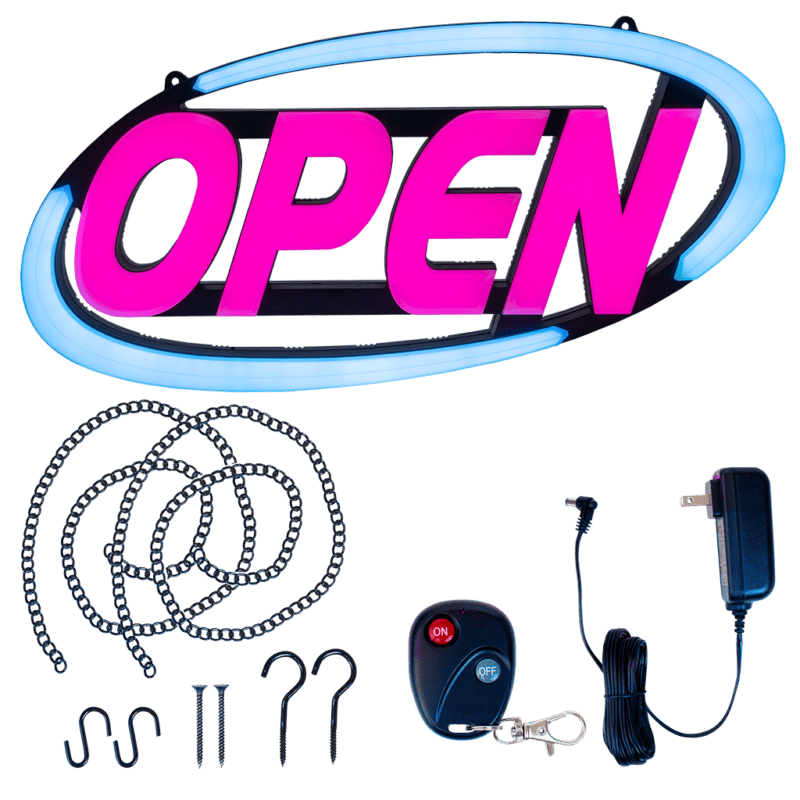
Sign “packages” with unnecessary accessories: some sellers bundle adapters, remote controls, and carrying cases with basic signs. The sign is what you need. Evaluate the sign’s specs independently — if the package is priced correctly, great. If the bundle is inflating the cost, buy the sign alone.

Where to Buy

We sell direct at greenlightinnovations.com. We’ve been has designed and sold LED business signs since 2008.

If you need help picking the right sign for your window size and use case, our sizing guide covers the window-size-to-sign-size matrix, and our U.S.-based service team is reachable directly for any question that the guide doesn’t answer.

Shop LED open signs → See the sizing guide → Request a quote for 5+ signs →


Green Light Innovations has designed and sold LED business signs since 2008. Veteran-founded. 3-year warranty, standard.

How to Buy LED Business Signs for a Franchise Group or Multi-Location Chain

Posted by

If you manage signage for more than five locations, the math on buying decisions changes completely. A choice that works fine for one store quietly becomes a budget problem, an install headache, and a brand liability across twenty.

This guide covers what actually matters when you are buying at volume: consistency, pricing tiers, replacement logistics, and how to find a vendor who will still pick up the phone after the sale.


The Hidden Cost of Inconsistent Signage

Walk into two locations of the same brand and see different signs in the window — different sizes, different colors, different brightness levels. It happens constantly in franchise groups and regional chains, usually because individual location managers bought whatever was cheapest on Amazon at the time.

The cost is not just aesthetic. It is:

Installation time. Every non-standard size means a custom mounting bracket, a different drill pattern, and a field tech spending an extra 45 minutes per location. Multiply that across a 30-location rollout and you have burned two full workdays on variation alone.

Replacement confusion. When a sign fails at Location 14, whoever handles facilities has to figure out which model that location has, find the right replacement, and hope it ships fast enough that the window is not dark for a week. If every location has the same sign, the replacement workflow is identical every time.

Brand presentation. A sign that is the right size for a 12-foot storefront window reads completely differently in a 6-foot recessed entry. When you are not specifying by location type, you get visual inconsistency that no amount of brand standards documentation can fix.

The fix is straightforward: standardize on one or two models, specify them by location type, and buy in enough volume that replacement stock makes financial sense to carry.


Volume Pricing: What to Expect

GLI’s pricing tiers are structured for business buyers at every scale. There is no application form and no approval process — the discount applies automatically based on quantity ordered.

Quantity Discount
1–9 units List price
10–24 units 5% off
25–49 units 10% off
50–99 units 15% off
100–249 units 20% off
250+ units Custom quote — email sales@greenlight-innovations.com

For a 25-location rollout at $229.92 list on the GLI1057B, the 10% tier puts you at $206.93 per unit — saving you $575 on that order. At 50 units, the 15% tier saves you $1,725 versus single-unit pricing.

These tiers reset per order, so a staged rollout across quarters benefits from batching location groups into single purchase orders where your timeline allows.


Standardization Strategy: One Model Per Location Type

The most effective approach for a multi-location operator is a two-model standard:

Primary storefront model. One SKU that goes into every full-sized window. For most restaurant and retail operators, this is a 15×32 sign at the standard Bluetooth-scheduling model. See GLI’s sizing guide for the window-width calculation — the rule of thumb is the sign should occupy 40–60% of the usable window width.

Secondary door-frame or secondary-window model. A 15×16 or 7×18 vertical for smaller openings, secondary windows, or locations with setback entries where a full-width sign would be oversized.

Write the two-model spec into your brand standards document alongside your sign placement rules. When a new location opens, the facilities team pulls the spec, orders the right model, and installs to your mounting standards. No judgment calls in the field.

Color matching. All GLI open signs are 64-color Bluetooth-controlled. Before rollout, choose your brand’s primary and secondary colors in the sign’s palette — the hex values are in the app — and document them. Every location manager gets the color profile pre-configured. The sign arrives, they scan the QR code, load the profile, done.


Replacement and Spare-Parts Strategy

Signs fail. Usually the failure is a driver board or a power supply, not the LED panel itself. The question is how fast you can get the location back to operational.

Rule of thumb: one spare unit per ten locations. If you manage 20 locations, carry two spares in your facilities storage. When a location fails, you ship the spare unit overnight, get the location operational within 24 hours, and send the failed unit back to GLI for warranty service or repair evaluation.

Why this beats the alternative. Waiting for a standard-shipping replacement on a live failure costs you 3–7 days of dark window time. At a location doing $3,000/day in revenue, the difference between overnight and standard shipping on a spare is not a cost — it is a multiplier on the warranty value you are already paying for.

Warranty logistics. GLI’s 3-year warranty covers defects in materials and workmanship. For multi-location accounts, contact [sales@greenlight-innovations.com] to discuss replacement shipment logistics under warranty — specifically whether replacement units ship before or concurrent with return of the failed unit, which matters for your spare-stock math.


Install Consistency: Sizing and Mounting Standards

Consistent installation across locations requires three things documented before the first unit ships:

1. Window dimension spec by location type. Measure the usable glass width at your standard storefront. Run the calculation from GLI’s sizing guide once, confirm the model, and put that model number in your standards document. Do not let field crews make this call independently.

2. Mounting height standard. For window signs, the bottom of the sign should be at eye level from the street — typically 48–60 inches from the sidewalk, adjusted for your typical grade. Pick the number, write it down, enforce it.

3. Mounting method. GLI units ship with suction cup mounts for glass installs. If your locations use hanging cables, display hooks, or wall-mount brackets for non-glass surfaces, specify that in your standards and include the hardware with the sign. For install guidance by surface type, the install guide covers glass, drop ceiling, wall, and exterior under-awning configurations.

Every location that follows the standard looks like every other location. That is the point.


What You Actually Need From a Vendor

Most LED signs sold through Amazon and Alibaba fulfill one requirement: they ship. The support chain after delivery is either slow, overseas, or nonexistent.

For a single-location owner replacing a sign every few years, that might be acceptable. For a multi-location operator, the calculus is different:

  • When a sign fails at a location, you need to reach a person who knows the product, can confirm whether it is a warranty issue, and can tell you what the replacement lead time is before you make a business decision about spare stock.
  • When you are mid-rollout and the 14th unit arrives damaged, you need a replacement shipped the same day, not a returns portal that routes to a third-party fulfillment center.

GLI is a veteran-founded business that has been has designed and sold LED signs since 2008. U.S.-based service. When you email, a person responds.
For your vertical category — restaurant, salon, or retail — additional product guidance and vertical-specific configurations are on these pages:

To get a bulk quote for 25 or more units: email [sales@greenlight-innovations.com] with your location count, preferred model (or a description of your storefront type if you are unsure), and your timeline. You will get a response within 24 hours with pricing and logistics details.


Case Study: [PLACEHOLDER — Tim to fill in]

[Insert: one multi-location customer — franchise group, regional chain, or property management company — that ordered 10+ units. Cover: what they were replacing, what model they standardized on, volume tier they hit, any install or replacement story. 100–150 words. Source from Amazon reviews or direct customer contact.]


GLI signs are designed for storefronts, not living rooms. If you are buying for a chain or franchise group and want to talk through a standardization spec before placing an order, email [sales@greenlight-innovations.com].

Bluetooth LED Sign Scheduling for Franchises: Stop Opening Late on Weekends

Posted by

Franchise operators have a specific open-sign problem that single-location owners don’t: inconsistency across locations. One manager flips the sign on at 8am. Another forgets until 9:15. A third leaves it running until midnight because closing cleanup takes longer on Fridays. None of this is visible to the corporate office until a guest complaint surfaces.

Bluetooth scheduling on LED signs solves exactly this. It’s not a complex feature — it’s a timer with seven-day granularity that runs whether or not a staff member thinks to touch it.

What Bluetooth Scheduling Actually Does

A Bluetooth-enabled LED sign like the GLI1057B or GLI1050B connects to a smartphone app. Inside the app, you set:

  • On time and off time for each day of the week
  • Different schedules for weekdays versus weekends
  • Holiday overrides (turn off automatically on days the location is closed)
  • An instant override toggle for impromptu closures or extended hours

Once configured, the schedule lives on the sign. You don’t need to be in Bluetooth range — you don’t need the app open — the sign runs its schedule independently. The app is only needed to change the schedule.

Range: most Bluetooth sign controllers operate reliably within 30-40 feet. For initial configuration, someone physically at the location needs to pair the phone once. After that, schedule changes can be done remotely in most configurations by having a manager on-site open the app — or by distributing the login credentials to regional managers.

The Franchise Operations Problem

If you manage 5+ locations, you already know the issue: weekend morning opens are inconsistent. The reason is usually the same — weekend crew is different from weekday crew, opening procedures are less drilled, and the open sign is often the last thing anyone thinks about.

The downstream effect is real. Customers driving past a location at 9am on a Saturday who see a dark sign assume you’re closed. Some will check Google. Most won’t. They’ll go somewhere else and potentially establish a habit of going somewhere else.

For a franchise group doing $800K per location annually, even a 0.5% walk-in loss from inconsistent signage adds up quickly across 10 locations.

Bluetooth scheduling eliminates this class of error. If the sign is configured to turn on at 8am Saturday, it turns on at 8am Saturday regardless of which manager opened.

How to Roll Out Across Multiple Locations

The right approach depends on your IT/ops structure:

Option 1: Central configuration, distributed execution

Your ops team or a designated regional manager holds the sign app credentials. They configure each sign at installation time — one visit, 10 minutes per sign. Ongoing schedule changes are handled centrally and pushed when staff at the location opens the app within Bluetooth range.

This works well for chains where a district manager already visits locations weekly.

Option 2: Location-manager delegation

Each location manager has access to the sign app for their location only. They configure their own hours, with a standardized schedule template provided by corporate. Corporate sets the expectation; managers execute. This distributes accountability but requires a brief training — the app is not complicated, but you need to document the setup.

Option 3: Single-schedule deployment

For franchise groups where every location has identical hours (common in fast casual), set one universal schedule template and replicate it across every sign. If hours ever change chain-wide, you update the schedule at each location on the next manager visit. For locations with seasonal or regional hour variations, this approach needs modification.

Volume Purchasing and Standardization

If you’re buying signs for multiple locations, standardization matters more than price-per-unit. Running the same sign model at every location means:

  • One training document covers every location
  • Replacement stock is interchangeable
  • Troubleshooting is consistent (everyone gets the same answer)

We provide volume pricing for orders of 10+ signs and can provide NET-30 terms for qualified commercial accounts. A quote request with your location count and sign requirements gets a response within 24 hours.

Request a volume quote →

For chains standardizing on a specific sign model, we can pre-configure units before they ship — saving your managers the initial setup time and ensuring every sign arrives ready to run.

What Bluetooth Scheduling Does Not Solve

Be clear-eyed about what this feature handles and what it doesn’t:

  • It handles consistent on/off timing. It does not handle the door being locked, the lights being off, or the kitchen not being staffed.
  • It handles automatic schedule execution. It does not integrate with your POS or staff scheduling software — if a location calls out sick and can’t open, someone still needs to manually override the sign.
  • It handles remote schedule changes via app within Bluetooth range. It does not enable fully remote sign control from an office 500 miles away without someone on-site opening the app. (Full remote sign management requires a WiFi-connected sign, which is a different product category — we can discuss that for large commercial deployments.)

The value of Bluetooth scheduling is specifically: eliminating the human memory requirement for routine on/off operations. That’s a real and recurring operational problem in franchise and multi-location businesses, and this feature solves it at the sign level.

Recommended Signs for Franchise Deployments

GLI1050B — 15×32 LED Open Sign with Bluetooth: Standard commercial format, 64-color display, business-hours scheduling. Most ordered by restaurant and retail franchise groups.

GLI1057B — LED Open Sign with Extended Brightness: Same Bluetooth functionality at higher peak brightness. Recommended for south-facing windows and high-ambient-light storefronts.

GLI1058 — LED Open/Closed + Business Hours Display: Displays business hours in addition to open/closed status. Common at locations with posted hours on the sign itself.

All models carry our 3-year warranty and are serviced by our U.S.-based team in Lake Saint Louis, Missouri.

Shop all Bluetooth LED signs → Request a multi-location volume quote →


Green Light Innovations has shipped commercial LED signs to businesses in all 50 states since 2008. veteran-founded company. U.S.-based service.

Spanish-Language Abierto LED Signs: Compliance, Market, and Why It Matters for U.S. Small Businesses

Posted by

About 42 million people in the United States speak Spanish as their primary language at home. In cities like Los Angeles, Miami, San Antonio, Houston, and New York, a Spanish-language “Abierto” sign is not a novelty — it’s practical business signage for a specific customer base that represents a $3.4 trillion annual purchasing power in the U.S. market.

This is not a trend piece. This is about a real business question that storefront owners in high-Spanish-density zip codes should be thinking about: does your open sign speak to the people walking past it?

What “Abierto” Means and Who Buys These Signs

“Abierto” is Spanish for “open.” An Abierto LED sign serves the same function as an English “Open” sign — it tells the street that you’re taking customers right now. The difference is which customers notice it first.

Businesses that typically run Abierto signs:

  • Restaurants in primarily Spanish-speaking neighborhoods
  • Beauty salons and nail salons serving a Latino clientele
  • Bodegas, carnicerías, and small grocery stores
  • Smoke shops and convenience stores in mixed-language markets
  • Medical and dental offices serving Spanish-speaking patients
  • Tax preparation and financial services offices

In many of these contexts, the Abierto sign is the primary signal that a business is culturally accessible to Spanish-speaking customers — before they read the menu, see the staff, or hear anyone speak.

Is There a Legal Compliance Requirement for Bilingual Signage?

The short answer is no — at the federal level, there is no law requiring private businesses to display signage in any language other than English. The ADA governs accessible signage (braille, tactile lettering, contrast requirements for permanent room signs) but does not mandate language.

State and local rules vary. Some cities with large Spanish-speaking populations have passed local ordinances about signage in certain contexts — typically around required public-safety notices, food handler labeling, or employment postings. These are specific to context, not general commercial signage.

The compliance angle that does matter: if your business is required to post any regulatory notices — health department grades, inspection results, fire capacity, workers’ compensation notices — some states require these in both English and Spanish if your workforce is predominantly Spanish-speaking. This is separate from your open sign, but worth knowing.

For your open/closed sign specifically: there is no federal or state requirement that it be in any particular language. The decision is commercial, not legal.

The Market Case: When an Abierto Sign Pays for Itself

In neighborhoods where 50%+ of foot traffic is Spanish-speaking, an English-only “OPEN” sign captures a fraction of your potential walk-in audience. People who aren’t fluent in English sometimes don’t register “OPEN” as a clear signal — they’ll look for other cues. An Abierto sign removes ambiguity.

This is not a political statement. It’s the same reasoning that drives businesses in tourist districts to post hours in multiple languages, or that leads Chinese-restaurant owners in Mandarin-heavy neighborhoods to display characters prominently. Signs exist to communicate. If the sign doesn’t communicate to the people walking past it, it’s not doing its job.

Businesses in places like East Los Angeles, Little Havana in Miami, the West Side of San Antonio, and Jackson Heights in Queens are obvious candidates. But this also applies to medium-sized cities with growing Latino populations: Charlotte, Nashville, Columbus, Indianapolis — cities where the demographic has shifted significantly since 2010.

The simplest test: stand in front of your location on a busy afternoon. What percentage of the people walking past appear to be Spanish speakers? If the answer is more than 30%, an Abierto sign will recoup its cost in additional walk-ins within weeks.

Dual-Language Signs: Open/Abierto in One Unit

Several of our signs display both English and Spanish, alternating or shown together. The GLI1050B in its 64-color programmable version can cycle between custom messages, which owners in bilingual markets use to alternate “OPEN” and “ABIERTO” every few seconds — or to display both simultaneously if the sign is large enough to support it.

This approach is common for businesses that serve a genuinely mixed market. The sign speaks to everyone walking by without requiring two separate signs.

If your customer base is strongly skewed toward Spanish-speaking customers, a dedicated Abierto sign positioned prominently in your window is often more effective than a cycling dual-language message. Dedicated is clearer.

Choosing the Right Abierto Sign: Specs That Matter

Brightness: If your storefront faces direct afternoon sun, you need a sign with enough nit output to be readable in high ambient light. Standard LED signs run at 1,000-1,500 nits. Signs in south-facing or west-facing windows in Sunbelt states should be at the higher end of that range. Ask your supplier for nit ratings — not just “super bright.”

Size: The same window-sizing rules apply as for any open sign. 15×32 inches is the most common commercial format. See our sizing guide for specific recommendations by window size.

Mounting: Suction cups to glass work for most applications. Chain hang from a ceiling bracket gives a cleaner look in retail and dining environments. See our installation guide for full instructions.

Bluetooth scheduling: If you’re running specific business hours, a Bluetooth-enabled sign lets you automate on/off by day of week. This matters as much for an Abierto sign as for any other — the sign being on when you’re closed sends exactly the wrong message.

Color: Red and green are the most common color choices for open signs. Red is highly visible in daytime conditions. Green reads strongly at dusk and in lower-light conditions. Many owners choose a sign that displays in both colors, alternating by time of day or cycling continuously.

Where to Buy Abierto LED Signs

We stock Abierto signs in standard formats and can configure dual-language cycling messages on Bluetooth-enabled models. All signs ship with a 3-year warranty and U.S.-based support.

View Abierto LED signs → See vertical landing pages by business type →

If you’re buying for multiple locations or need a volume quote, use the quote form and we’ll respond within 24 hours with NET-30 options.

A Note on Representation

Running an Abierto sign is not performative. Businesses that serve Spanish-speaking communities have been doing this for decades — it’s practical signage, and it works. The growth in the U.S. Spanish-speaking population since 2000 means this is a larger opportunity than it was even ten years ago.

If your storefront is in a high-density Spanish-speaking area and you’re not running an Abierto sign, you’re running a sign that isn’t working as hard as it could.


Green Light Innovations has designed and sold LED business signs since 2008. Veteran-founded. 3-year warranty on every sign.

How to Install an LED Open Sign at a Restaurant (Without Losing Customers During the Swap)

Posted by

Replacing a dead or dim open sign at a restaurant is a 45-minute job if you plan it. It becomes a two-day headache if you don’t. This guide covers the full process: what to buy, how to mount it, what the electrical requirements actually are, and how to make sure every driver passing your block can read it from 150 feet away.

We’ve shipped open signs to restaurants in all 50 states since 2008. The questions we get most often are not about the sign itself — they’re about what happens during and after the install.

Step 1: Measure Your Window Before You Order

This is where most restaurants get it wrong. They order a sign that’s the right width but too tall, and it blocks the view into the dining room — which kills the ambiance you spent money building.

Standard restaurant window heights range from 36 to 72 inches. For most commercial storefronts, a 15×32-inch sign (like the GLI1050B) is the practical sweet spot. It’s visible from the street, mounts at eye level in the upper third of the window, and doesn’t obstruct the sightline into the room.

If you have a drive-through window or a narrow transom window, look at the 10×27-inch format instead. For large plate-glass frontage on a corner location or high-traffic street, the 19×38-inch or larger gives you more visibility at speed.

The measurement rule: your sign should occupy roughly 25-35% of your window’s width. Any smaller and it disappears from the street. Any larger and it blocks your interior.

Step 2: Understand the Electrical Requirements

LED open signs run on standard 110-120V AC — the same outlet your espresso machine uses. Power draw is low: most 15×32 LED signs draw between 12 and 20 watts. That’s less than a standard incandescent bulb.

What this means practically:

  • You do not need a dedicated circuit. A standard wall outlet within reach of the sign location is sufficient.
  • You do not need an electrician for a basic hang. The sign plugs into the wall. There is no hardwiring required unless you want a flush-mounted installation with a hidden conduit.
  • Extension cords are fine temporarily, but not long-term. Run a proper outlet if you’re doing a permanent install. A grounded 3-prong outlet within 6 feet of the sign location is the goal.

One exception: neon signs (the gas-tube kind) require a transformer and draw substantially more power. If you’re switching from old neon to LED for the first time, you’ll likely find the LED version uses 80-90% less power and runs cooler.

Step 3: Choose Your Mounting Method

There are three practical ways to mount an LED open sign in a restaurant:

Option A: Suction cups to glass (most common)

Most LED open signs ship with suction cups. You press them to the inside of the window and the sign hangs in place. This works reliably for signs under 5 lbs — and most LED open signs are between 2 and 4 lbs.

Pros: no drilling, no damage to the window or frame, fully repositionable. Cons: suction cups can release in high-heat environments (direct south-facing sun in summer will heat the glass). Check the seal every few months.

Option B: Chain hang from a ceiling mount

Many restaurants prefer this for front-window displays. You install a small eyehook or ceiling bracket behind the window (usually into the drywall header), and the sign hangs on a lightweight chain. This looks cleaner than suction cups and positions the sign at exact eye level.

Pros: stable, professional appearance, adjustable height. Cons: requires a small drilling job (10 minutes with a stud finder and a basic drill).

Option C: Screws through the sign frame into a backer board

For a permanent install — say, a wall-mounted sign in the entry vestibule rather than the window — screw mounting through the sign’s rear bracket into the wall. Use the right anchor for your wall type (drywall anchor for stud-less installation, lag bolt into stud for heavier signs).

Most of our commercial customers at franchises and chain restaurants use Option B for window signs and Option C for interior wall signs.

Step 4: Position for Maximum Street Visibility

Where you hang the sign matters more than the sign itself. A 15×32 LED sign at the wrong position in a window is invisible from 50 feet away. The same sign at the right position is readable from 200 feet.

The three rules of placement:

  1. Upper third of the window, not the middle. Street-level pedestrians look up slightly. Drivers passing your restaurant look at approximately door-frame height. Hanging a sign at chest height means parked cars and other vehicles will block it.
  1. Driver’s side of the window, not centered. For restaurants on one-way streets, hang the sign on the side facing oncoming traffic. For two-way streets, center it — but lean toward the side with the parking lane, because that’s where people slow down.
  1. Avoid backlighting conflicts. If you have a bright interior light directly behind the sign’s position, it will wash out the LED display at certain angles. Move the sign to a position where the background is darker, or install a simple black backing card behind the sign to improve contrast.

Step 5: Configure Business Hours Scheduling (Don’t Skip This)

If you’re buying a Bluetooth-enabled sign like the GLI1050B or GLI1057B, the setup takes about 10 minutes on your phone — and it changes how you run the sign permanently.

The business hours mode lets you set on/off times for each day of the week. The sign turns itself on when you open and off when you close, automatically. You set it once, and you’re done.

Why restaurant owners specifically love this: kitchens open before the front of house, and closing routines are hectic. A sign that stays on until 11pm because someone forgot to flip it tells the street you’re still seating — which creates awkward situations. A sign on a timer doesn’t make that mistake.

Pair that with the open/closed toggle on the app for impromptu closures (private events, equipment failures, weather), and you have full control without anyone having to think about it.

Step 6: How to Handle the Swap Without Losing Foot Traffic

If you’re replacing an existing sign that’s been in the window for years, the gap period matters — even a few days without a visible OPEN sign costs you walk-in traffic.

The overlap approach: order the new sign before removing the old one. When the new sign arrives, do a same-day swap. Take the old sign down, put the new one up, plug it in, confirm it works, and you’re done in under an hour.

If the old sign fails suddenly: cover the window space temporarily with a large printed vinyl banner or cling — “OPEN” in big block letters. Most sign shops can do a 24-hour turnaround on basic vinyl. It’s not pretty, but it keeps your walk-in traffic during the gap.

Do not leave the window empty. A restaurant with no sign in the window looks closed. Even if your hours are on the door and Google, people driving by don’t read doors.

Troubleshooting Common Install Problems

Sign flickers or doesn’t light evenly: check the power connection first — wiggle the plug at both ends. If the issue persists, it’s usually a loose internal ribbon cable. Contact us directly; we cover this under the 3-year warranty.

Suction cups won’t hold: clean both the glass and the suction cup face with isopropyl alcohol before pressing. Wait 30 seconds before releasing. If the glass surface is textured or dirty, switch to Option B (chain hang) instead.

Bluetooth won’t pair: make sure you’re within 30 feet of the sign and your phone’s Bluetooth is on. Close the app and reopen it. If it still won’t connect, do a factory reset on the sign (hold the reset button for 8 seconds) and start the pairing process from scratch.

Sign is bright enough indoors but hard to see from the street: this is a placement issue 90% of the time. Move the sign higher in the window. If brightness is genuinely insufficient for a very bright storefront, the GLI1057B runs at higher peak brightness for high-ambient-light environments.

What to Do After the Install

Register your sign warranty at [greenlightinnovations.com/warranty/]. GLI signs come with a 3-year warranty — no fine print, no “limited” asterisks. If the sign fails within 3 years under normal use, we replace it.

Keep the original box if you have the storage space. Shipping a sign for warranty service requires the original packaging or comparable foam protection.

For questions after your install, reach our U.S.-based service team directly. We answer questions about mounting, configuration, and troubleshooting — not a chatbot, an actual person.

Shop LED Open Signs for Restaurants → See the GLI1050B — our most-ordered restaurant sign →


Green Light Innovations has designed and sold LED business signs since 2008. Veteran-founded. 3-year warranty standard on every sign.

About Green Light Innovations

Posted by

Built for Storefronts, Not Instagram

We’ve been making commercial LED signs since 2008 — before Bluetooth scheduling was a standard feature, before LED open signs had replaced neon across most commercial storefronts, and before there was a category called “custom neon decor.”

We make signs for businesses that use them to run their operation. The restaurant that needs its sign on at 4:30pm Friday and off at 11pm without anyone thinking about it. The nail salon that needs a sign that’s still running in five years without requiring a replacement. The franchise group that needs the same sign at 20 locations and a warranty they can actually rely on.

That’s not a glamorous pitch. It’s a description of what we build and who we build it for.


The Numbers

Founded: 2008 Signs shipped: 150,000+ (to businesses in all 50 states) [PLACEHOLDER: verify exact number from GLI-OS database] Products in catalog: 15+ commercial LED sign models Warranty: 3 years, standard on every sign Service: U.S.-based, Lake Saint Louis, Missouri


Our Background

Green Light Innovations is a veteran-founded business, certified through the U.S. We’ve held that certification since our founding. It’s not a marketing claim — it’s a legal classification with real documentation requirements and annual renewal.

Being veteran-owned informs how we run the business: we are direct, we honor commitments, and we don’t add fine print to our warranty to find ways out of it.

We manufacture and distribute from Lake Saint Louis, Missouri. Our service team is in the U.S.


The Founder

[PLACEHOLDER — Tim to write or approve this section. Suggested elements: name, military service branch and role, how the business started in 2008, connection to the LED sign market, what drives the product decisions. Target length: 2-3 paragraphs. Voice: first person or third person consistent with the rest of the about page.]


What We Sell

Commercial LED open signs, programmable message boards, and bilingual (English/Spanish) signs for storefronts in the restaurant, retail, salon, dispensary, fitness, and government verticals.

Our products are designed for businesses that operate 8-16 hours per day, 365 days per year. We spec for longevity — 50,000-hour LED ratings, 3-year warranties, commercial-grade housings — because that’s what a storefront sign needs to do.

We don’t sell custom neon decor or LED signs designed for interior photo backdrops. If that’s what you need, there are other suppliers who build that product. We build operational signage.


veteran-founded and Government Procurement


Our Warranty Promise

Every sign we sell carries a 3-year warranty against manufacturing defects under normal commercial use. The full terms are on our warranty page.

The short version: if the sign stops working within 3 years and it’s not because you dropped it or cut the cord, we replace it. No extended-warranty purchase required. No lengthy claims process.

We’ve been doing this for 16 years. We know what our signs can handle and we stand behind that.


Contact

U.S.-based service team

[PLACEHOLDER — support email] [PLACEHOLDER — hours of operation]

Mailing address Green Light Innovations [PLACEHOLDER — full Lake Saint Louis, MO address]

For government procurement inquiries: [PLACEHOLDER — dedicated government contact]


Shop our LED signs →

See sizing and installation guides →

How to Improve Your Storefront Appearance and Why An Open Sign is An Important Part of Your Business

Posted by

As more shopping moves online, brick and mortar shops have to work hard to stand out. Appearance matters and you need to do all you can to attract customers. 

Here’s the good news: It’s easy to enhance your store’s appearance. 

All it takes is cleanliness, eye-catching details, and the ever-essential open sign. An LED or neon open sign tells the public your store is ready for business and acts as an invitation at the door. 

Choosing where to buy an open sign can be tough. Green Light Innovations is one of the best places to buy open signs on the internet. We offer customizable options and environmentally-friendly design. 

Read on to learn more about: 

  • Why an appealing storefront is important 
  • How to improve your store’s appearance
  • The significance of LED and neon open signs for your business 
  • Why Green Light Innovations is the right choice for you

Why a Welcoming Storefront Matters

Yes, shopping is moving online — but not all of it. According to a Service Channel study, 86% of consumers shop at physical store locations for more than half of their purchases. 

A Retail Customer Experience survey found that 95% of consumers say a store’s exterior appearance factors into their decision about whether to shop there. Another poll noted that 80% of consumers would try a new store if the exterior were properly maintained and inviting. 

First impressions matter. 

If your business is nestled in a strip mall or on the side of a busy road, you want to provide a welcoming place for people to stop for lunch or send their dry cleaning. Take time to focus on your storefront, and stock up if you’re missing any details like benches or an LED open sign. 

How To Create an Attention-Grabbing Storefront

It’s easy to neglect your storefront if you devote all of your attention to your business’s interior and products. Those aspects are indeed essential. But, if people avoid your store because of a dirty sidewalk or burnt-out LED open sign, then it doesn’t matter how good your offerings are.

Here are a few tips for improving your storefront:

  • Create a friendly environment 
  • Keep your store clean
  • Make your store visually appealing 
  • Buy an open sign 

Create a Welcoming Environment

Take in the big picture of your store by looking at it from a distance. Does it look inviting and friendly? And if not, why is that? 

Can you buy a few plants or provide some outdoor seating for your guests? Do you need to add a welcome mat or sweep the sidewalk? Even small touches can make a big difference. 

Maintain Your Store Space

Be sure to keep your storefront clean and maintained, whether you hire someone or do it yourself. Ensure the sidewalk is swept, fix any holes in the pavement, and keep your windows nice and clean.

Also, make sure to prepare for shifting weather. That might mean umbrellas on your tables for hot days or having tools available to combat ice build-up. 

Make Your Signage Interesting 

Signs work. Be thoughtful when designing your signage. Make sure it’s easily recognizable from a distance and that it gives visitors a sense of your store. 

A funny store name or a creative sign can show your personality and intrigue potential visitors. 

Find Out Where To Buy an Open Sign

A neon or LED open sign tells customers far and wide that you are open for business. 

When deciding where to buy an open sign, skip the wholesalers and choose a business that cares about its product. At Green Light Innovations, we don’t treat open signs as an afterthought — because they shouldn’t be. 

The History of Open Signs

Open signs have been a staple of the business world for a very long time. But one of the biggest advancements in open signs came in the early 1900s when French inventor George Claude introduced the neon sign at the Paris Motor Show. 

Since then, the neon sign has developed a rich history in American culture. Neon signs came to the U.S. in the 1920s and could cost as much as a few thousand dollars. If a business could afford something as expensive as a neon sign, it was a “sign” the business was doing well. 

It wasn’t until the 1980s that the classic neon open sign became a staple for businesses. As technology advanced, neon open signs gave way to LED open signs, giving business owners more options to customize their signs.  

The Significance of Open Signs

A neon open sign might seem inconsequential, but it’s an essential piece of the puzzle that can lose or gain business. If your open sign is broken, customers might assume you’re closed, and they’ll head to a competitor instead. 

But more than that, a neon or LED open sign is a signal of hope. An open sign serves as a beacon of connection between businesses and consumers, whether they’re braving a winter storm in search of supplies or trying to find an open business during a pandemic. 

Open signs show resiliency for small businesses. Turning yours on is a show of pride. 

Best Place to Buy Open Signs: Green Light Innovations

Whether you opt for a traditional neon open sign or a customized LED open sign, Green Light Innovations has what you need. 

We offer affordable choices that are long-lasting and reliable to ensure your business’s success. 

At Green Light Innovations, we care about our products. We work to ensure our open signs are energy conscious and feature the latest technology. We provide a high standard of quality for our customers and strive to offer business solutions with integrity. 

We have a variety of sign choices and can even work with you to create a custom sign. Whatever you need, we’ve got you covered, down to the chargers and batteries.

Final Thoughts: Better Business with Neon and LED Open Signs 

An attention-grabbing storefront will help attract more visitors, which will increase sales and your business’s longevity. 

Spend time making your storefront inviting for customers. Make sure your sidewalk is clean, signage is appealing, and that there’s an LED or neon open sign in the window. 

Don’t overlook the importance of an open sign and what it can do for your business. Green Light Innovations is the best place to buy an open sign if you’re a business owner looking to spruce up your storefront. 

Do you have a unique idea for an open sign? Work with Green Light Innovations to create your custom vision today.